
Part I: The Extraction Code - The Code They Use When They're Lying to You
How 'patient-centered care' means 'we're denying your claim' — and 47 other phrases that mean the opposite of what they say
Series: The Extraction Code
Part I | Part II | Part III-A | Part III-B | Part III- C | Part IV-A | Part IV-B | Part V
Become an Investigative Partner. Paid members receive:
Daily Intelligence Briefings - Yesterday’s news, decoded by morning. See the extraction pattern before your second cup of coffee.
Weekly Case Files - One real victim. One institutional lie. Line-by-line deconstruction with courtroom-grade sources.
Monthly Pattern Reports - Connect the dots across healthcare, finance, and policy. The 30,000-foot view.
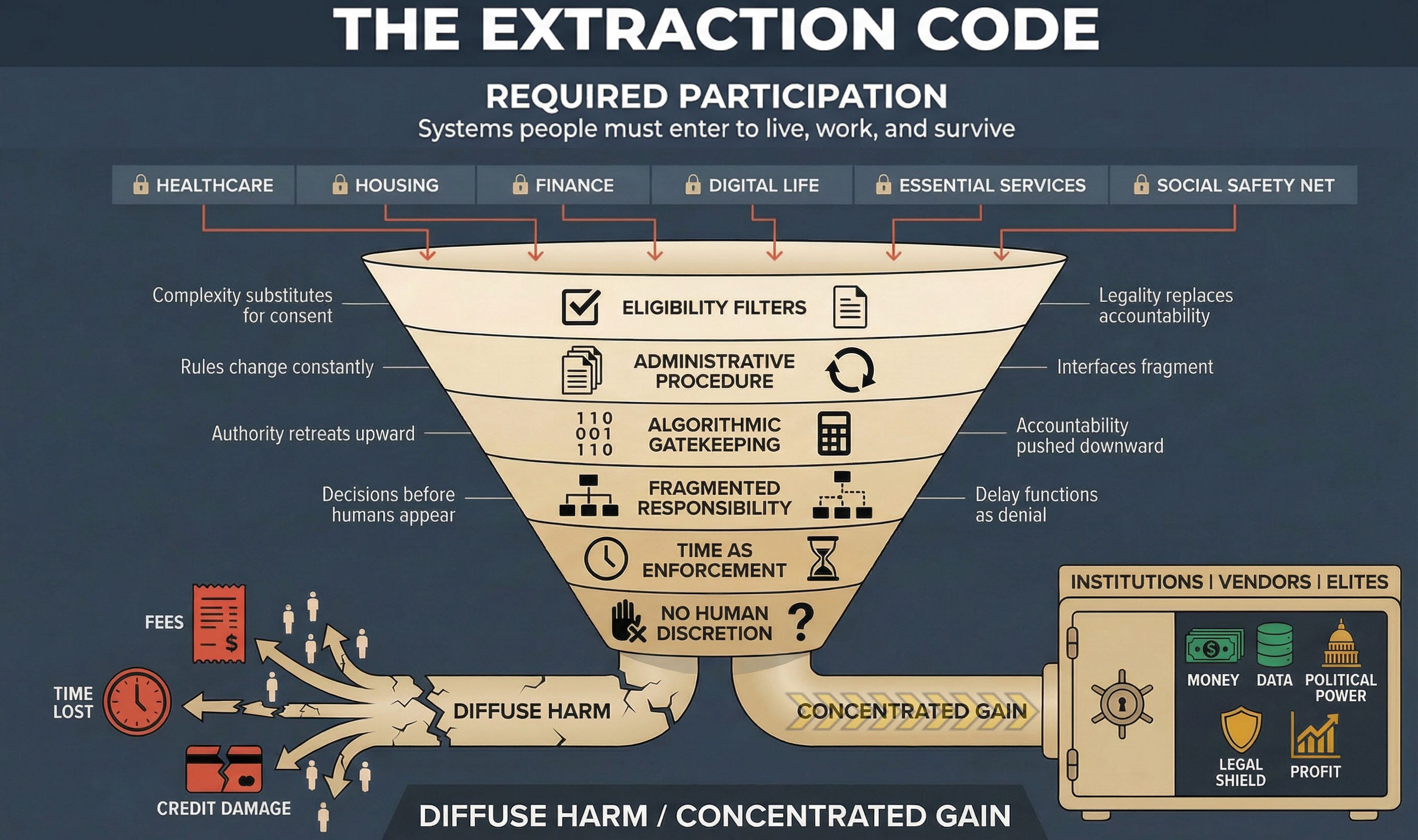
A framework you can apply in real time: who must enter, where friction is added, who can say no, and where the gain concentrates.
➤ Subscribe Now: Introductory offer: 25% off monthly and annual paid subscriptions through Jan 23, 2026.
The System Didn’t Evolve. It Was Engineered.
The Extraction Code is not a natural outcome of complexity or an accidental byproduct of bureaucratic growth. It is the result of deliberate policy choices, lobbying campaigns, regulatory capture, and institutional redesign spanning five decades.
What we experience today as “the system”, healthcare prior authorization labyrinths, algorithmic benefits denial, platform terms of service that strip user rights, housing application processes designed to filter people out, represents the successful consolidation of extraction infrastructure across sectors, parties, and administrations.
This infrastructure was built through:
Legislative choices that prioritized market-based solutions over public provision, creating mandatory systems people cannot opt out of while ensuring those systems are operated for profit.
Regulatory erosion that shifted enforcement away from protecting individuals and toward protecting institutional “flexibility,” allowing corporations to write their own compliance rules.
Technological adoption that automated decision-making without accountability, replacing human judgment with algorithmic gatekeeping that operates at scale, in secret, under proprietary protection.
Procedural complexity was deliberately introduced to raise the cost of access, not in dollar terms that could be challenged as discriminatory, but in time, literacy, persistence, and navigational capacity that punish the most vulnerable while appearing facially neutral.
The system didn’t fail. Rather, it was redesigned to work this way.
The Architecture of Power: Who Built This and Why
The Corporate Transformation (1980s-1990s)
The foundation was laid during the shift from stakeholder capitalism to shareholder primacy, when maximizing returns to investors became the legal and cultural mandate of corporate governance.
In healthcare, this meant insurers were no longer risk-pooling mechanisms but profit-optimization platforms. We now have a system where profit optimization happens through incentives, not legal mandates, which actually makes it MORE insidious because executives can claim “we’re just responding to market forces” rather than “we’re legally required to do this.” In finance, deregulation removed the barriers between commercial and investment banking, allowing predatory lending, fee extraction, and risk externalization to become standard business models.
In technology, platform monopolies emerged with business models built on surveillance, data extraction, and user lock-in, and they wrote terms of service that made participation mandatory while stripping users of rights, recourse, and alternatives.
Key mechanism: Corporate consolidation. Mergers and acquisitions reduced competition, giving a handful of firms market dominance in each sector. Once you control the chokepoints, health insurance, payment processing, and digital infrastructure, you can extract rents from participation itself.
The Outsourcing Revolution (1990s-2010s)
Governments at every level began outsourcing core functions to private vendors, replacing public accountability with contract opacity.
Benefits administration, eligibility determination, fraud detection, data management, even prison operations and child welfare services were transferred to for-profit corporations operating under proprietary systems with minimal oversight.
Key mechanism: Fragmented responsibility. When a Medicaid applicant is denied, who decides? The state agency? The eligibility vendor? The verification contractor? The fraud detection algorithm? The answer is deliberately unclear, and that ambiguity is the point. Accountability dissolves across the contract chain.
The Algorithmic Turn (2000s-present)
Automation allowed extraction to scale beyond human capacity while providing legal cover. Algorithms don’t discriminate (legally speaking), they just optimize for outcomes their designers chose.
Prior authorization systems deny care automatically. Fraud detection flags benefits applicants based on proxies for poverty. Credit algorithms punish people for financial instability caused by medical debt or wage theft. Hiring platforms filter out applicants based on employment gaps caused by caregiving or disability.
Key mechanism: Opacity as shield. Proprietary algorithms operate in secret, exempt from disclosure requirements, protected as trade secrets even when they determine access to healthcare, housing, or income. You can’t challenge what you can’t see. You can’t appeal to a formula.
The Regulatory Capture Cycle (Ongoing)
Industries don’t just lobby for favorable laws; they write the regulations, staff the agencies, and ensure enforcement priorities align with corporate interests rather than public protection.
Pharmaceutical companies draft drug approval processes. Health insurers design insurance regulations. Financial institutions shape consumer protection rules. Tech platforms write privacy frameworks.
The result: regulation becomes a barrier to entry for competitors and a compliance theater for incumbents, while doing little to constrain extraction.
Key mechanism: Revolving door. Regulators come from industry, return to industry, and write rules that protect industry. Former Wall Street executives staff the SEC. Pharmaceutical companies influence the FDA. Tech monopolies with infinite legal resources outmatch the FTC.
The Bipartisan Consensus
One of the most essential facts about the Extraction Code is that both parties built it.
Democrats embraced market-based reforms, means-testing, public-private partnerships, and “innovative” outsourcing as pragmatic solutions that could pass Republican opposition. The Affordable Care Act preserved and expanded the private insurance extraction model. Welfare reform introduced punitive procedural barriers. “Reinventing government” meant privatizing accountability.
Republicans accelerated deregulation, tax cuts that defunded enforcement, and ideological opposition to public provision of anything corporations could profit from. But they also defended extraction infrastructure when it served corporate donors, fighting to preserve prior authorization, arbitration clauses, and algorithmic opacity.
The system crosses party lines because both parties rely on corporate funding, prioritize “efficiency” over accessibility, and have accepted the premise that essential services should be run for profit.
The fights are over who gets blamed when the system fails, not over whether the system should be redesigned.
The Immunity Layer: Why Extraction Is Legal
The final piece of the architecture is legal immunity.
Contracts and terms of service that force arbitration, waive class action rights, and disclaim liability for harms caused by the platform, algorithm, or process.
Qualified immunity for government actors and vendors who violate rights while following procedure.
Proprietary protection that prevents disclosure of how decisions are made, blocking accountability through trade secret law.
Preemption statutes that prevent states from regulating industries more strictly than federal minimums, ensuring a race to the bottom.
Standing requirements that make it nearly impossible to sue over systemic harm, you must prove individual injury, not pattern, and by the time you can prove it, the system has moved to a new vendor or policy.
The system is designed to be legally unassailable, not because it’s just, but because the rules were written by those who profit from it.
What This Means
The Extraction Code is not a conspiracy. It doesn’t require coordination or secret meetings. It is infrastructure built over decades through observable policy choices, lobbying influence, regulatory capture, technological adoption, and bipartisan political consensus.
You cannot opt out because these systems were deliberately made mandatory.
You cannot navigate them successfully because they were deliberately designed to impose friction.
You cannot hold anyone accountable because responsibility was deliberately fragmented, automated, and legally shielded.
And you cannot reform them through exposure alone because the system was built to survive scandal without changing its structure.
Recognizing this is not cynicism. It’s an acknowledgement.
And acknowledgement is the necessary foundation for resistance.
Transition: From Power Structure to Operational Design
Understanding who built the Extraction Code and why is essential context. But understanding how it actually works, the specific mechanisms that convert required participation into concentrated gain, requires examining the system’s operational architecture.
This is where infrastructure becomes experience.
Where policy becomes procedure.
Where power becomes process.
What Paid Members Unlock Each Week
The Extraction Code you’ve just read about, the deliberate policy choices, regulatory capture, corporate consolidation, and bipartisan infrastructure that built America’s extraction systems over five decades, didn’t emerge from headline-chasing journalism.
It emerged from time-intensive investigative work that institutional media cannot or will not initiate and sustain.
What this analysis required:
Reviewing decades of policy documents, GAO reports, congressional testimony, and regulatory changes
Tracking corporate consolidation patterns across sectors
Mapping the outsourcing revolution through contractor databases and federal spending records
Documenting algorithmic adoption through court cases and technology vendor disclosures
Connecting legislative histories across administrations and party control
What institutional media produces instead:
“Insurance Company Denies Cancer Treatment” (outrage, no system analysis)
“Veteran Faces Deportation” (sympathy, no pattern documentation)
“Benefit Recipients Struggle With New Requirements” (human interest, no infrastructure mapping)
Each story gets clicks. None of them explains why the same harms persist after the scandal fades.
That’s what Barking Justice Media exists to do.
The Independence This Work Requires
This isn’t personality-driven commentary. This isn’t party-aligned advocacy. This isn’t ad-supported content optimized for engagement metrics.
This is investigative journalism and systems analysis built outside the constraints that compromise most institutional media.
What Paid Subscribers Receive
Daily Intelligence Briefing (3 Signals + Counter-Moves)
Every weekday: Three extraction signals translated from code to operational reality, with specific counter-moves you can deploy before harm lands. See the systems before they see you coming.
Weekly Deep Dive (Extraction of the Week)
Every week: An in-depth investigative analysis of one extraction pattern in action, fully sourced, funnel-mapped, with accountability chains and documentation trails you can verify.
Monthly Sector Analysis
Every month: Comprehensive examination of extraction infrastructure across sectors (healthcare, housing, finance, digital life, social safety net, child welfare, labor), with pattern documentation, vendor analysis, and cumulative case evidence.
Paid membership unlocks the daily intelligence, weekly deep dives, and monthly analysis that fund:
The 40-60 hours/week this work requires
FOIA requests, database access, and court document retrieval
The independence to follow evidence instead of metrics
The ability to say, “This will take three months to document properly” instead of “We need content tomorrow.”
This is not about buying opinions. This is about funding time, rigor, and independence.
The difference between exposure and explanation.
Between outrage and understanding.
Between headlines that fade and maps that endure.
The Moment We’re In
Democracy doesn’t collapse in a single dramatic moment. It erodes procedurally, through exemptions that create unaccountable power, outsourcing that obscures decision-making, algorithms that replace judgment, and administrative barriers that quietly replace consent with compliance.
By the time people feel powerless, the infrastructure producing that powerlessness is already mature, embedded, and operating at scale.
Recognition is the first act of resistance.
And recognition requires documentation that institutional media will not sustain.
That’s what your paid subscription funds.
Not flashy headlines. Not viral outrage. Not tomorrow’s forgotten scandal.
The canvas of what’s happening now, documented with enough rigor to be defensible, enough clarity to be actionable, and enough independence to be trusted.
If this work has value to you, if understanding the system is worth more than just reading about individual failures, consider supporting it.
Subscribe Now: Introductory offer: 25% off monthly and annual paid subscriptions through Jan 23, 2026.
If you can’t afford a paid subscription right now, that’s completely understood. Free subscribers are essential to this work; you read, you share, you help make the patterns visible. That matters enormously.
And if you can support this work, you’re making it possible for others to access it.
Continue to Part II: The Extraction Funnel - How Required Participation Becomes Concentrated Gain →
 | A guest post by
|
Thank you very much for offering the free membership. I was disabled in mid-career by disease. I’m now quickly approaching 70 and was recently approved for a Medicaid Waiver so that I’d have a place to live! Assisted living gave me the apartment, but it is taking a big chunk of my SS income. All the money I’d saved for retirement is gone paying for a Medicare Supplemental Insurance that went up to $300/month before I could qualify for Medicaid.
I have 3 Master’s degrees in Biological Science, Ministry and Special Education. I’m not a rare individual in my living facility who were professionals who had to retire early before retirement savings were not even close to being fully funded. You bet I will share your findings amongst others here! I surely wish I could support your research and the publishing of the findings. I pray that you will continue to find those who are able.