
After the Next Attack, Will We Demand Accountability or Surrender More Power?
PART 6: 9/11 showed how fear turns rushed votes into permanent authority. The first 72 hours after the next catastrophe will decide whether democracy holds or blank-check power hardens.
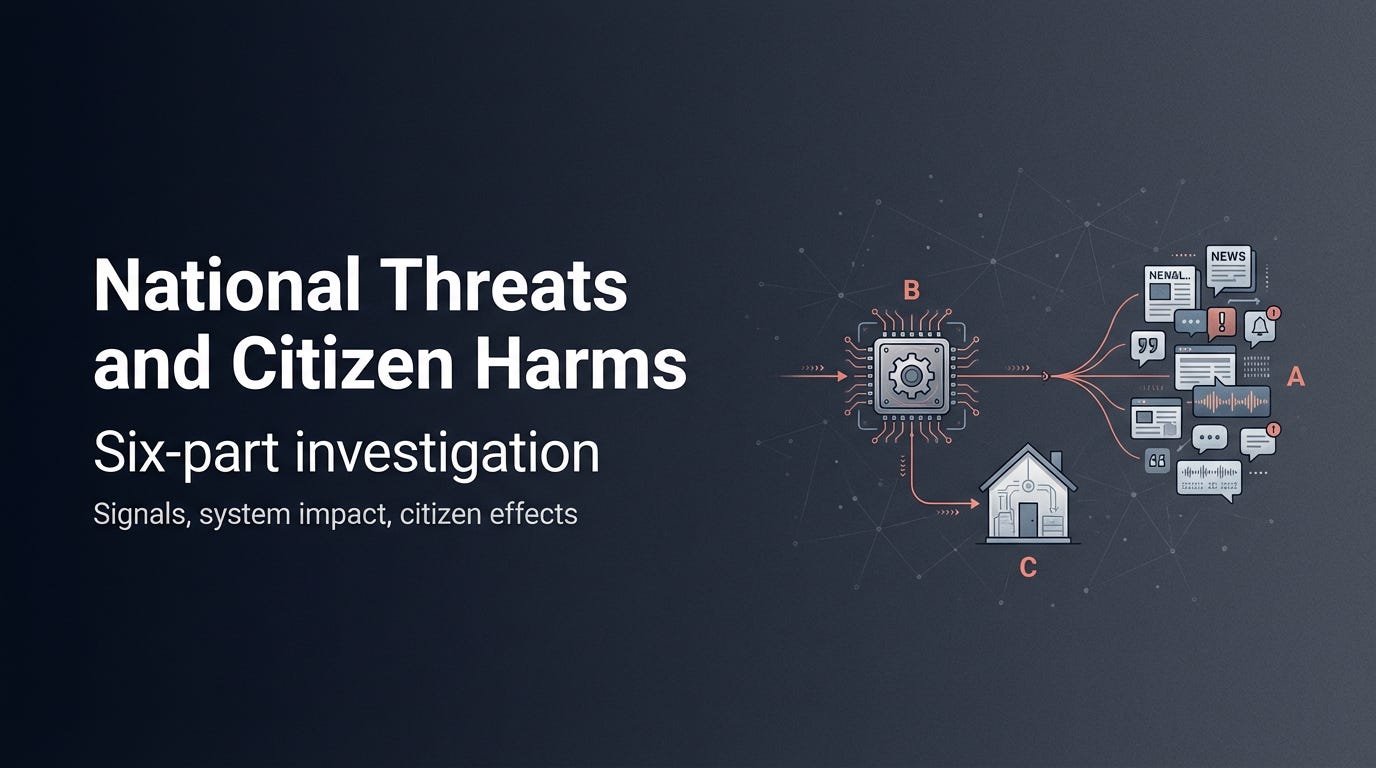
The Firing Line | Barking Justice Media
March 10, 2026
By Mika Douglas and Robert Anderson
═══════════════════════════════════
National Threats and Citizen Harms:
Part 6 of 6 | After the Next Attack, Will We Demand Accountability or Surrender More Power?
═══════════════════════════════════
The Moment That Defines Everything
September 12, 2001, 8:46:40 a.m. Exactly 24 hours after the first plane hit, America faced a choice it did not know it was making.
Would we demand accountability for the warnings that were missed, mishandled, or never properly shared, from early FBI alarms and presidential warnings to the CIA-FBI failures that left known al Qaeda operatives living openly in San Diego?
Or would we accept a simple story, grant sweeping new powers in the name of safety, and let fear erode civil liberties in ways that could last a lifetime?
We know which choice we made.
In 60 seconds:
After 9/11, America faced two paths. One demanded evidence, accountability, and enforceable reform. The other demanded speed, sweeping authority, and trust. The second path won because it moved faster in the first 72 hours. That speed built permanent machinery that outlived the crisis.
The question is what we do when the next catastrophe lands. Parts 1 through 5 of this series documented how vulnerability is being manufactured in real time. After the next hit, the choice between accountability and blank-check power will not be made in a healthy republic. It will be made in a country with weaker guardrails, lower trust, and a Congress operating under incentives that reward speed, spectacle, and partisan advantage over scrutiny.
New readers: Start here with our Reporting Standards to see our sourcing, verification labels, and how we track patterns from early signals to citizen harm.
I. What 9/11 Actually Taught Us, and What We Chose to Forget
In the months after 9/11, two responses emerged. One pointed toward accountability and democratic renewal. The other pointed toward permanent emergency rule.
Only one survived.
Response 1: The accountability moment
For a brief window, Americans asked the right questions.
Four widows from New Jersey, Kristen Breitweiser, Patty Casazza, Lorie Van Auken, and Mindy Kleinberg, lost their husbands in the towers. They became to be known as the “Jersey Girls” and emerged as the most effective public advocates for an independent investigation, fighting the Bush administration at nearly every turn.
They did what most Americans never did: they read the documents.
They pushed through stonewalling, forced sworn testimony, challenged conflicts of interest, and helped drive the formation of the 9/11 Commission after months of resistance. When Henry Kissinger was appointed chair, they interrogated conflicts and the appointment collapsed under scrutiny. They were not chasing a headline. They were building a record.
What the families wanted:
Full accountability for officials and agencies that missed, mishandled, or buried warning signals
Systemic reforms to prevent the next attack
A public reckoning proportionate to the failure
What they got: the 9/11 Commission Report, released on July 22, 2004, nearly three years later.
The deeper accountability the families wanted never arrived in proportion to the failure, and key reforms were implemented unevenly.
Response 2: The authorization moment
Three days after the attack, Congress passed the Authorization for Use of Military Force (AUMF) by overwhelming margins. One member of Congress, Rep. Barbara Lee, voted no. She warned against an open-ended war with no exit strategy and no focused target.
She was right. She was isolated. She was attacked.
Then came the rushed appearance of leadership:
October 2001: PATRIOT Act
The bill moved so fast that meaningful review was truncated. The political atmosphere did not reward caution. It punished it.
November 2001: Military commissions authorized
January 2002: Guantanamo opens
March 2003: Iraq invasion began
The pattern was set:
Crisis → Fear → Authorization → Expansion → Normalization → Permanence
Accountability is slow. It requires admitting failure, naming incompetence, punishing allies, rebuilding systems, and staying engaged after the cameras move on.
Authorization is fast. It feels like leadership. It feels like action. It also creates permanent machinery that outlives the crisis.
We chose speed and we are still paying for it.
II. The Civic Awakening That Got Crushed
The Jersey Girls represented the path we did not take. They showed what sustained civic pressure looks like, and why power works so hard to kill it.
What they achieved:
Forced the creation of a commission against White House resistance
Forced testimony from senior officials who initially resisted appearing, and later forced sworn public testimony from Condoleezza Rice
Exposed conflicts and pushed the investigation forward
Stayed on the record when most of the country moved on
What they could not prevent:
By the time the Commission’s work reached the public, the post-attack architecture was already built. The expanded surveillance architecture was already in place. The wars in Afghanistan and Iraq were already underway.The accountability window had closed.
They kept pushing anyway, and the backlash was immediate and strategic. They were called partisan. They were smeared. They were treated as suspect for asking the most basic civic question: How did this happen?
That is a lesson, too. When you demand accountability, the system will try to convert your questions into a character flaw.
III. The Authorization That Never Ended
The post-9/11 “temporary” posture did not behave like a temporary posture.
Emergency authorities and surveillance capabilities expanded quickly, then persisted through renewals, renamings, and quiet reauthorizations. The public did not re-consent to the new baseline. It was simply told the baseline had changed.
What became thinkable after 9/11:
Broad surveillance with limited transparency
Detention without meaningful due process
Secret processes producing secret orders
Wars without clean endpoints
“Classified” as a default shield against scrutiny
This is the core institutional fact: once emergency authority is granted, it rarely snaps back on its own. It has to be forced back.
IV. The Choice We Face Now
This series is not arguing that catastrophe is inevitable on a fixed date. It is arguing something more actionable:
We are building the conditions in which catastrophe becomes easier to trigger, harder to prevent, and more profitable to exploit.
The next major national shock could come from many directions:
A grid-level cyberattack
A public-health event that overwhelms capacity
A climate disaster that breaks response systems
A debt or liquidity event that cascades
Domestic political violence exploiting institutional chaos
A coordinated incident amplified by allied distrust and intelligence fragmentation
When it happens, the country will face the same fork it faced on September 12, 2001.
Path 1: Accountability (the hard path)
Fund emergency response fast, but refuse to bundle it with sweeping new authority
Demand oversight mechanisms in writing, before the vote
Insist on sunsets, audits, judicial review, and public reporting
Organize sustained pressure after the emotional peak fades
Rebuild expertise and defensive capacity instead of expanding blank-check power
Path 2: Authorization (the easy path)
Accept “whatever it takes” as sufficient justification
Grant sweeping authorities quickly because speed feels like safety
Allow fear to punish scrutiny as disloyalty
Normalize the new baseline, then forget it was new
Discover too late that “temporary” was never designed to end
If the system wants a power expansion, it will sell it as rescue.
V. Why This Time Could Be Different, or Worse
In 2001, institutions were strained but still functional. The media ecosystem was narrower. Trust and shared facts were battered but not shattered. Career expertise still anchored many systems.
In 2026, we are operating in a context defined by:
Deliberate institutional gutting and political purges
A fractured information environment optimized for rage
Weakened oversight norms and captured guardrails
Allies reducing reliance and building parallel systems
Higher fragility across infrastructure, supply chains, and debt
Faster exploitation through contracting, privatization, and security outsourcing
That context makes accountability harder to sustain and makes authorization more dangerous to grant.
The next emergency would hit a country with weaker guardrails, less expert capacity, and a more fragmented public reality than existed in 2001.
After the next shock, the pressure will be extreme. The speed will be weaponized. The public will be told that asking questions is betrayal.
That is why Part 6 needs to end with something more than a warning. It needs a protocol.
Paid subscribers get the Reconstruction Protocol: the 72-hour accountability checklist, the Evidence Ledger framework, the citizen call script, and the oversight tracker designed for the first days after a national shock.

Continue reading this post for free, courtesy of Barking Justice Media.
 | A guest post by
|
 | A guest post by
|