

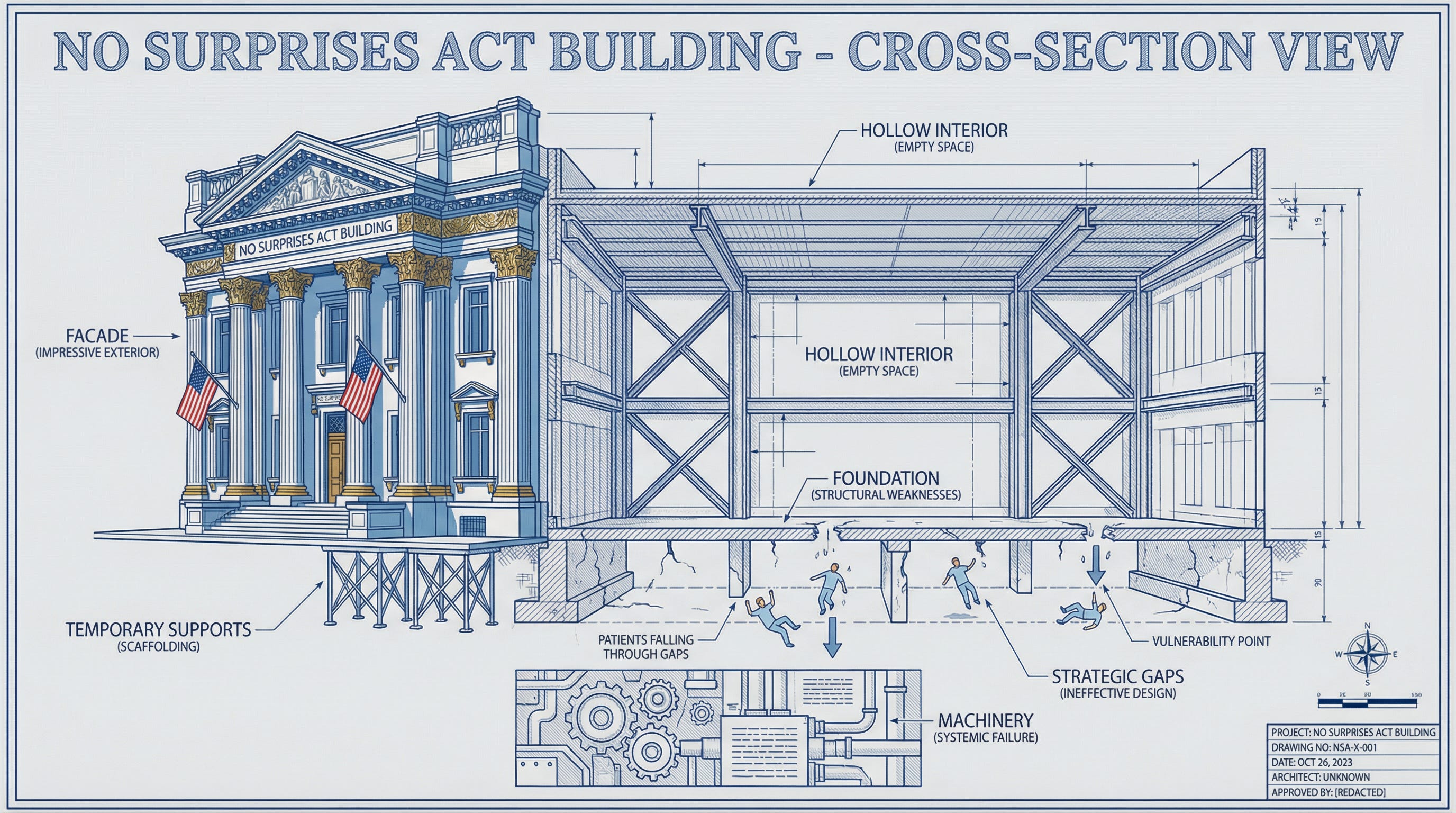
PART 2: The Mechanics of Failure
Recap: When Protection Is Theater
Part 1 showed you that the No Surprises Act exists, creates patient rights, and includes enforcement mechanisms. It also showed you that the public enforcement picture is incomplete, and that the system can still reward aggressive billing even when patients eventually get relief.
That raises the question Part 2 answers: Is this a breakdown, or the system working as intended?
In 60 seconds, here’s what Part 2 proves:
IDR did not “grow.” It detonated: projected 22,000 disputes a year, actual volume in 2024 exceeded 1.46 million.
Providers initiate the disputes at scale, as standard operating procedure, not as rare exceptions.
Providers win the majority of payment determinations, quarter after quarter.
For emergency department services, the median prevailing offer in 2024 was roughly 2.5 to 3 times the insurer’s Qualifying Payment Amount (QPA).
The QPA baseline is calculated by insurers with minimal independent verification, and audits have found calculation errors and noncompliance.
Household impact: these costs do not vanish; they surface as premium pressure, deductible drift, and faster accounts moving toward collections.
The evidence points to design. Not a conspiracy, something more mundane and more troubling. This is healthcare reform theater: a repeating pattern in which Congress passes laws that appear to be patient protection while preserving industry profits.
The No Surprises Act isn’t an outlier. It’s the template.
If you are dealing with a bill right now, the paid section includes the Defense Kit routine that keeps you from paying the wrong amount before you verify what you actually owe.The IDR Explosion: What The Law Actually Created
When Congress created the Independent Dispute Resolution (IDR) process, the government projected that 22,000 disputes would occur annually between providers and insurers.
The reality in 2024: more than 1.46 million disputes were initiated.
That’s 66 times the projection. And the pattern of who disputes what reveals the business model the law created.
Providers initiate 99% of disputes. They’re not disputing that insurers occasionally lowball egregiously. They’re disputing systematically, at scale, as standard operating procedure.
Providers prevail in roughly 80% to 85% of payment determinations, depending on the quarter.
But here’s where it gets interesting: for emergency department services, the median prevailing offer in 2024 was roughly 2.5 to 3 times the insurer’s Qualifying Payment Amount (QPA).
Let’s walk through what this means in practice:
Insurance company sets Qualifying Payment Amount (QPA) at $1,000 (claiming this is the “median in-network rate”)
Provider disputes, claiming they should be paid $5,000
Arbitrator awards $2,800 (2.8x the QPA)
Provider gets 2.8x what insurer offered
The insurer pays less than the provider demanded
Both sides declare victory
Household consequence: the dispute costs do not vanish. They get priced into premiums, show up as deductible drift, and increase billing pressure as accounts move faster toward collections.
The patient, who was promised to be “out of the middle,” is indeed out of the billing middle. But they’re stuck in a system where both sides profit from disputing everything while claiming the other side is unreasonable.
UnitedHealthcare appears as the non-initiating party in roughly 30% of IDR disputes each quarter. That is not occasional disagreement. It is a systematic business practice: dispute at scale, win some, lose some, and create enough friction to keep the overall system profitable.
Insurer Complicity: The QPA Manipulation Problem
The Qualifying Payment Amount (QPA) is supposed to be the “median contracted rate” for a service in a geographic area. It’s the baseline number used in arbitration. In theory, it’s an objective measure.
In practice, insurers calculate their own QPAs with no independent verification.
In 2024, CMS published the first federal audit of Qualifying Payment Amount calculations, focused on certain air ambulance claims for Aetna Health Inc. in Texas. The audit found noncompliance and identified QPA calculation errors in multiple directions. At a minimum, it shows the baseline rate is not reliably self-verifying when the method is not independently audited.
Providers have alleged several recurring ways Qualifying Payment Amount (QPA) calculations can be pushed down. Not every allegation is proven in any individual bill, but the claims recur across markets and matter because QPA calculations are rarely audited.
Geographic gerrymandering: Insurers expand geographic boundaries to include cheaper areas, lowering the median. A specialist in Manhattan might have their QPA calculated using rates from across the entire New York metro area, including New Jersey suburbs, where rates are 40% lower.
Specialty mixing: Combining different specialties to lower the median. Ophthalmology rates are mixed with optometry rates. Interventional cardiology mixed with general cardiology.
Ghost rates: Including contracted rates from contracts with zero patient volume. An insurer might contract with one provider at an artificially low rate, never send them patients, but include that rate in the median calculation.
Code downcoding: Changing the billing code to a less expensive procedure, then calculating the Qualifying Payment Amount (QPA) for the cheaper code instead of what was actually performed.
There is no independent verification of any of this. The law requires insurers to provide their QPA calculation methodology upon request, but doesn’t require anyone to verify its accuracy.
This creates a profitable dynamic for both sides:
Insurers set low QPAs (reducing what they pay)
Providers dispute (going to arbitration)
Arbitrators award more than the Qualifying Payment Amount (QPA) but less than the provider demand
Both sides extract from the system while blaming each other
The industry. In 2024, more than 1.46 million disputes were initiated. Both sides profit. Patients are “protected” in the sense that they are not billed directly, but the costs are baked into premiums, deductibles, and the overall system cost.
The Setup: Who Actually Wrote This Law
Both private equity firms and insurance companies shaped the No Surprises Act. Both got the provisions they needed. Both profit from the “failure.”
The enforcement gap isn’t a bug. It’s what makes the business model work:
Weak complaint-driven enforcement means most illegal bills go unchallenged
No private right of action means even arbitration winners can’t force payment
No meaningful penalties mean illegal billing is just a refund risk
IDR process creates profitable disputes at scale
QPA manipulation is unaudited and unchecked
Patient protection is the marketing. Industry profit preservation is the mechanism.
But this isn’t unique to the No Surprises Act. This is how healthcare reform works in America.
You now have the mechanics: the volume, the win-rate dynamics, and the baseline number that can be pushed down without reliable verification. So here is the question that matters:
If a law is marketed as protection, but the incentives reward extraction, who wrote the rules, and why were the enforcement teeth filed down?
Subscribe to unlock two advantages:
The Surprise Billing Defense Kit, so you can respond the moment a bill arrives: what to request, what to document, and how to stop the timeline from turning into collections.
The Reform Theater Field Guide, so you can spot the script early: who writes the law, how enforcement gets neutralized, and what actually forces change.
In the paid section, you will see why the Affordable Care Act, price transparency rules, and drug pricing “reform” followed the same pattern, and how to predict the next failure before it’s sold as protection.


