

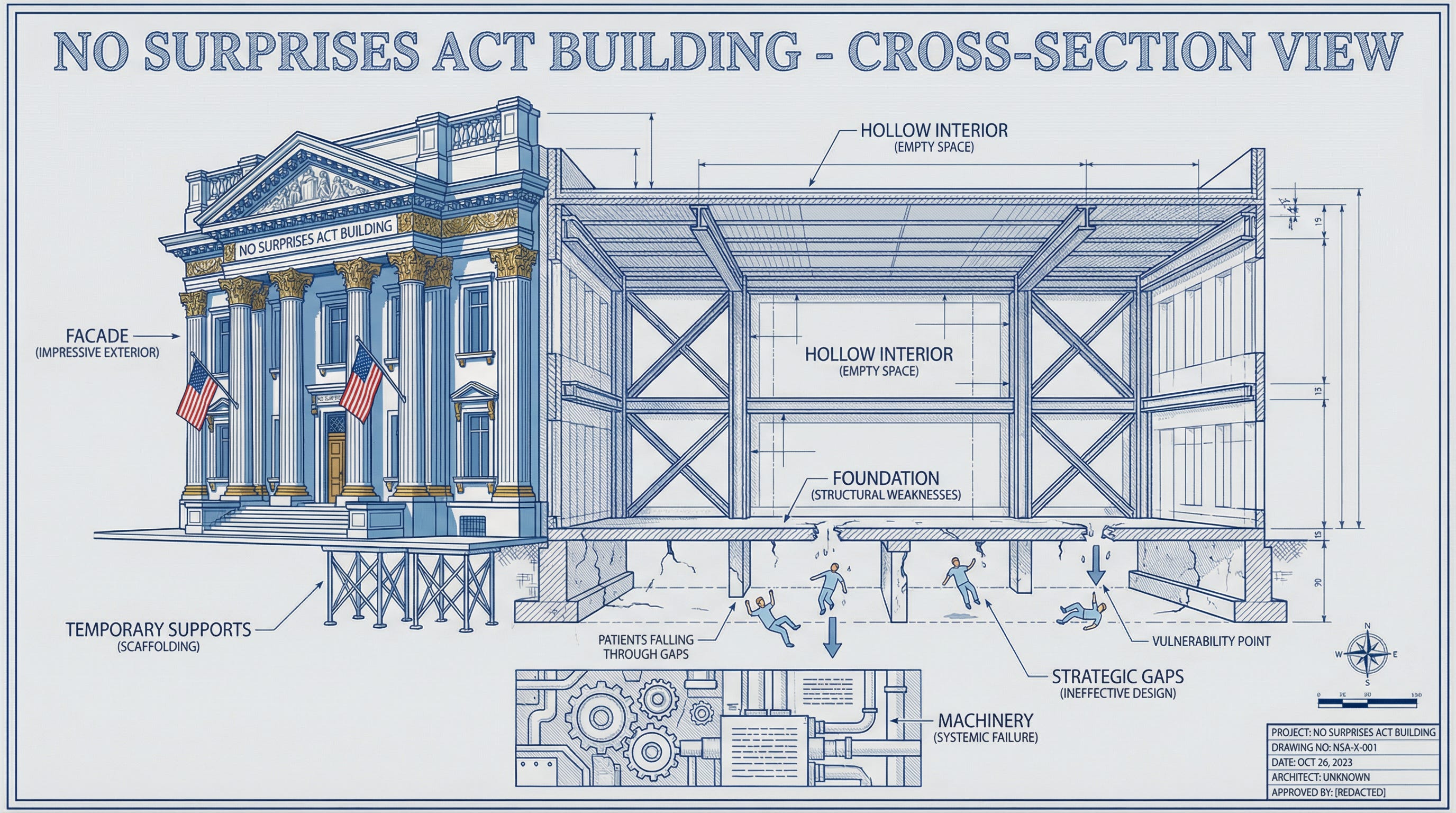
Surprise billing did not survive because Congress forgot to outlaw it.
It survived because the system that extracts payment runs on speed, confusion, and silence.
“Surprise billing” is simple: you receive care you did not choose under conditions where choice is impossible, then you get billed as if you had negotiated the price.
In 2022, the No Surprises Act took effect. In the situations it covers, patients are NOT supposed to be in the middle. You pay only your in-network cost sharing. Providers and insurers fight the rest out through a dispute process.
And yet, bills still arrive with “patient responsibility” language, a balance due, and a deadline.
This investigation asks: If the law is real, why does the billing machine behave as if it is not?
Part 1 shows the mechanism. Part 2 shows the incentives that keep it alive.
What you will learn in this piece
The real definition of “surprise billing” and why it is so effective
Where the No Surprises Act applies, and where it does not
The collections sequence that pressures patients into paying first and asking later
The three documents that determine your leverage: itemized bill, EOB, and your written record
The first verification step that prevents costly mistakes: bill vs EOB
PART 1: The Illusion of Protection
The No Surprises Act was sold as a clean fix. In practice, it created a protection on paper and a collections reality in your mailbox.
By September 30, 2024, CMS reported receiving 18,799 complaints and closing 15,303. Violations were found in 1,294 closures, and in 2024, more than 1.46 million federal Independent Dispute Resolution disputes were initiated between providers and insurers.
Those numbers indicate that the billing machine is still working.
To see how, start with a case from before the law existed, when the only effective enforcement tool was public pressure.
The Drew Calver Case: When Media Worked and Law Didn’t
In April 2017, Drew Calver had a heart attack. He was rushed to St. David’s Medical Center in Austin, Texas, the nearest emergency room. He didn’t choose the hospital. He couldn’t have. He was having a heart attack.
Four days later, he was discharged with a bill for $164,941. His insurance company, Blue Cross Blue Shield of Texas, paid $55,840. That left Calver responsible for $108,951.
For emergency care. At the nearest hospital. For a condition he didn’t choose to have.
Calver didn’t have $108,951. Most Americans don’t. He faced the same choice millions of Americans face every year: financial ruin or non-payment and credit destruction.
Then Kaiser Health News and NPR published his story.
Within 48 hours, the hospital dropped his bill to $332.
Internal emails from St. David’s CEO David Huffstutler, obtained through public records requests, reveal what happened behind the scenes. Huffstutler wrote that the media coverage made it “difficult to neutralize the coverage” and that the hospital needed to “move quickly” to resolve the case.
Translation: The publicity was damaging. Make it go away.
Zack Cooper, a Yale health economist who studied the case, told NPR: “It really is scandalous that it takes a story in the national media for a patient to not face financial ruin.”
He was right. But here’s what matters for understanding the No Surprises Act: media pressure worked. The law, which didn’t exist yet, wouldn’t have.
What The Law Actually Says
The No Surprises Act took effect January 1, 2022. It prohibits surprise billing in three situations:
Emergency services at any hospital
Non-emergency services from out-of-network providers at in-network facilities (like an anesthesiologist you didn’t choose)
Air ambulance services
Important limitation: The No Surprises Act covers air ambulance, not ground ambulance. A surprise bill from a ground ambulance can still be legal under federal law, although some states have separate protections.
In these situations, you pay only what you would have paid if the provider had been in-network, your usual copay, coinsurance, or deductible based on in-network rates. The provider cannot bill you for the difference between what they charged and what your insurance paid.
Under the No Surprises Act, Drew Calver would have owed only his in-network cost-sharing for emergency care. In the reporting on this case, that figure was described as about $3,200, not $108,951.
That’s the promise: patients are out of the middle. If providers and insurers can’t agree on payment, they go to arbitration through a process called Independent Dispute Resolution (IDR). The patient’s responsibility is fixed at the in-network amount.
The law includes enforcement mechanisms. You can file complaints with the Centers for Medicare & Medicaid Services (CMS). Providers who violate the law face civil monetary penalties up to $10,000 per violation.
On paper, it looks like protection.
The Collections Timeline That Still Works
Envision Healthcare was one of the largest emergency room staffing companies in America before filing for bankruptcy in 2023. Their bankruptcy filings revealed internal training materials and standard operating procedures, including their four-phase collections protocol.
Days 1-30: Bills go out with “patient responsibility” language. No mention of the No Surprises Act. No mention of network status. Just a bill with a balance due.
Days 31-60: Follow-up notices escalate to credit damage warnings. Payment plan offers appear. Still no mention of patient protections or network status.
Days 61-90: “Settlement” offers arrive. The hospital or provider offers to reduce the bill, often to 25-30% of the original amount. This sounds generous until you realize the legal amount owed is closer to 3-5% of the original bill. The “settlement” is still three to four times what the patient legally owes.
Days 91+: Collections, credit reporting, lawsuits, wage garnishment.
The training materials are explicit: staff should avoid discussing network status and redirect billing questions to insurance companies. The mechanism is simple: extract payment before the patient discovers their rights.
This isn’t a few bad actors. This is standard operating procedure, documented in bankruptcy court, refined over years of practice.
Enforcement By The Numbers
As of September 30, 2024, the federal government reports:
18,799 complaints received (15,303 closed)
1,294 closed complaints with a violation found
$11.3 million in monetary relief paid to consumers or providers
Average monetary relief per violation found: $8,733
Those numbers require context.
First, the $11.3 million figure is ‘monetary relief’ reported by CMS. The public summary does not break out civil monetary penalties. The law allows penalties up to $10,000 per violation, but CMS public reporting focuses on monetary relief rather than a penalty tally.
Second, the complaint totals are not a clean violation rate. CMS closed 15,303 complaints. It reported 1,294 closures with violations found and 5,106 closures with no violations found. Public reporting does not explain the disposition of the remaining 8,903 closed complaints.
Third, these are only the complaints that were filed. The collections timeline reveals the real problem: most patients pay before they know they can complain.
The gap between the law’s promise and these numbers raises an obvious question: Why is enforcement this weak?
The answer is in how the law was written and who wrote it.
You now know what the No Surprises Act covers, what it does not cover, and how the collections sequence pressures patients into paying before they verify what they actually owe.
The next question is practical: what do you do when the bill is already in your hands, and the clock is running?
Paid subscribers get both the documentation routine that protects you in real time and the investigative record that explains why this keeps happening.
Subscribe to unlock the Surprise Bill Defense Pack and the paid investigative record:
• The step-by-step documentation routine that keeps the timeline on your side: itemized bill, EOB comparison, call log, and written dispute
• The ready-to-send No Surprises Act complaint package, including what to attach and how to frame the violation so it is harder to dismiss
• The collections defense protocol from the Defense Kit, including what to say, what not to say, and how to force everything into writing
• Part 2: the machinery behind the gap, including the lobbying war, the Guardian Flight enforcement constraint, what actually happens inside the complaint process, and why this model stays profitable
Next in Part 2 (a separate post with its own free preview): why the dispute pipeline exploded, how enforcement gets neutralized in practice, and what to save before the timeline closes.


