
America’s Constitution Under Attack: How Rapid Erosion of Rights Is Reshaping Democracy in 2025
A Complete, Evidence-Based Analysis of Federal and State Threats to Civil Liberties, Voting, Free Speech, and Equal Protection—And What Citizens Can Do Now to Defend Democracy
The Current State of the U.S. Constitution: Erosion, Pending Actions, Vulnerabilities, and Impact (September 2025) - Repost
Executive Summary
Since 2021—and accelerating in 2025—the United States has witnessed a surge of federal and state measures that threaten core constitutional rights. This includes legislative actions, executive orders, regulatory changes, and ongoing/high-profile litigation targeting fundamental liberties. Below is a comprehensive review, with fresh details on pending cases and an analysis of the most at-risk constitutional sections and what these trends mean for the American public.
Ongoing and Pending Legal and Legislative Actions (Fall 2025)
Major Pending Supreme Court Cases
Campaign Finance/Democracy:
National Republican Senatorial Committee v. FEC—will examine limits on coordinated expenditures between parties and candidates, potentially affecting the balance of political power and the First Amendment’s free speech protections.Birthright Citizenship—Fourteenth Amendment:
Significant 2025 executive orders seek to limit birthright citizenship; a pending challenge is before the Supreme Court, with lower court injunctions in effect in some circuits. Resolution could radically alter the Equal Protection Clause and its application to marginalized groups.Abortion/Healthcare Rights:
Several cases, including challenges to state restrictions post-Dobbs, are pending before the Court. These involve Medicaid funding for women’s health care and the constitutionality of abortion bans and clinic regulations.Transgender Protections and Civil Rights:
Challenges to recent executive orders targeting transgender individuals in incarceration, healthcare, and sports are pending. The outcome will clarify the extent of Equal Protection rights for LGBTQ+ communities.Election Law and Voting Rights:
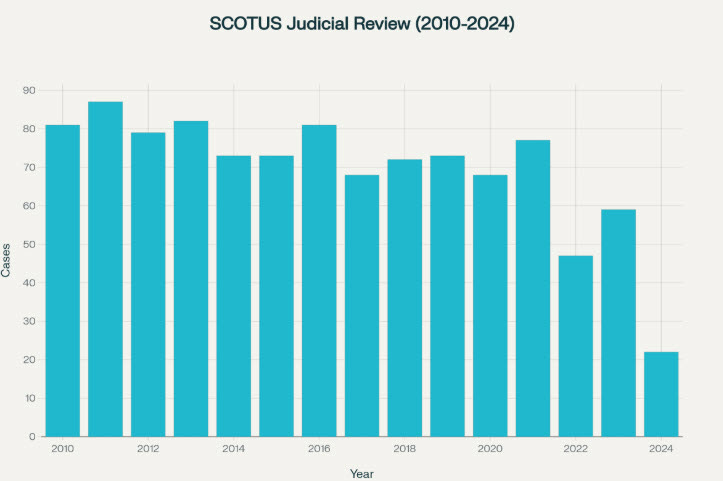
Litigation over the SAVE Act (voter registration documentation), state-level purges, and Section 2 of the Voting Rights Act is proceeding through the courts. One major case will address challenges to state laws extending mail-ballot deadlines, which could potentially affect federal elections(see the image above).
Noteworthy Executive and Regulatory Actions
Administrative State and Chevron Deference:
The end of Chevron deference in Loper Bright v. Raimondo continues to drive a wave of litigation challenging federal agency actions, affecting domains from environmental regulation to social benefits and civil rights enforcement.Sanctuary Policies and Grant Conditions:
Ongoing suits challenge the Trump administration’s efforts to tie federal funding for cities, states, and universities to compliance with controversial administration policy stances, notably on immigration and trans rights.Freedom of Access to Clinics and Federal Non-Enforcement:
Lawsuits challenge the DOJ’s move to stop enforcing the FACE Act, potentially increasing threats to abortion providers and clinics nationwide.
Most Vulnerable Constitutional Sections (2025)
First Amendment: Speech, Press, and Academic Freedom
Threats:
Defunding public media, suppressing academic institutions, and jawboning private platforms remain at the core of current attacks. Pending mega-defamation suits raise the specter of self-censorship and press intimidation.Impact:
The chilling of dissent limits public oversight, weakens democratic deliberation, and allows government and corporate abuse.
Fourteenth Amendment: Equal Protection/Birthright Citizenship
Threats:
Executive orders and state laws seek new ways to limit or redefine equal protection, discrimination safeguards, and birthright citizenship.Impact:
Risks include statelessness for some children, targeted disenfranchisement, and loss of recourse for those subject to discriminatory policies, especially communities of color and LGBTQ+ individuals.
Fifteenth Amendment & Voting Rights
Threats:
The SAVE Act, aggressive voter roll purges, and mail-in ballot restrictions represent a coordinated effort to narrow the electorate, especially among youth, the poor, and minorities.Impact:
These changes could shift electoral outcomes, reduce public faith in democracy, and embolden further restrictions.
Fourth & Fifth Amendments: Due Process, Search & Seizure
Threats:
Expansion of expedited removal procedures and mass administrative orders limits procedural safeguards.Impact:
Increased risk of wrongful deportation, denial of legal process, and erosion of the “rule of law” across various regulatory contexts.
Women’s and Reproductive Rights (Ninth, Fourteenth Amendments)
Threats:
State and federal actions seek to curtail abortion access, restrict health funding, and limit gender-affirming care.Impact:
Resulting disparities in health, autonomy, and personal freedom, especially for low-income and marginalized women.
Eighth Amendment
Threats:
Green-lighting punitive, local anti-homeless ordinances raises the bar for Eighth Amendment “cruel and unusual punishment” protections.Impact:
Exposes vulnerable populations to increased criminalization and loss of basic shelter or supportive services.
Structural Vulnerabilities
The difficulty of formal amendment—the “unamendability” problem—places enormous power in the hands of those who can work through reinterpretation, regulatory action, and de facto precedent shifts. This means that because the U.S. Constitution is difficult to formally amend (due to Article V’s strict requirements), those in power often bypass the amendment process and instead change how constitutional rights are understood and enforced by:
Reinterpretation: Courts or executive agencies interpret the Constitution’s meaning in new ways, which can significantly alter rights without changing the actual text.
Regulatory Action: Executive orders, agency rules, and indirect government action (like funding conditions or enforcement practices) can reshape the application of constitutional protections in daily life.
De Facto Precedent Shifts: Over time, repeated actions and judicial decisions can build new norms—effectively changing how the Constitution is applied, even if the text stays the same.
Additionally, “fractures in federalism” refers to the division of authority between federal and state governments. Because states have considerable independence and differing political climates, constitutional rights can vary widely depending on where someone lives. This fragmentation makes unified national resistance to rights erosion hard to organize and creates unequal rights environments across states.
Broader Impact on the Citizenry
Civic Trust:
Each rollback, legal uncertainty, or chilling effect diminishes faith in government institutions and the sanctity of constitutional rights. Suppressed media and voting access dampen civic participation.Inequality:
Vulnerable groups—women, people of color, immigrants, LGBTQ+ individuals, the poor all bear the brunt of new laws, as basic protections become increasingly fragmented by geography, class, and local politics.Rule of Law:
The erosion of due process, equality before the law, and federal protection undermines the perception and reality of impartial justice.Democratic Norms:
As rights become conditional, provisional, and unevenly enforced, democratic checks and balances weaken—potentially affecting not just individual liberty but also the peaceful transition of political power.
Comparative, Historical, and Societal Context
Recent expert assessments compare the U.S. case to international examples of democratic backsliding, where executive power is systematically expanded via attacks on the press, academic institutions, electoral oversight, and the independence of courts. Chilling effects on opponents, crackdowns on civil society, and the use of state resources for political retribution coincide with an “authoritarian legal playbook” widely studied abroad.
Trends, Rate, and Extent of Constitutional Damage
Trend:
The U.S. is experiencing its most significant and coordinated contraction of civil liberties and democratic protections in modern memory, with moves designed to change policy and entrench durable structural advantages for those in power.
Rate/Extent:
Rights erosion is swift, with dozens of major executive orders, legislative acts, defunding moves, and court interventions within months. While lower courts have checked some actions, many legal frameworks have been rapidly rebuilt to evade judicial or public scrutiny. The combination of direct targeting and indirect chilling creates a multiplier effect, as restrictions in one domain amplify vulnerabilities elsewhere.
Unbiased Determination
The breadth of action against First, Fourth, Fifth, Eighth, Tenth, Fourteenth, Fifteenth, and other constitutional guarantees is unmatched since the civil rights era.
Recent policy (2024–2025) increasingly employs administrative and economic levers (defunding, grant conditions, mass firings, fast-track removals) that resist oversight or rapid reversal.
The Supreme Court has partially curbed, but not reversed, the core trend. Chevron’s demise means increased litigation is likely, but with unpredictable and potentially inconsistent protection for rights.
Civil society resistance is powerful but fragmented and is under pressure; legal experts widely agree that the risks of permanent constitutional slippage are at their highest level in decades.
Conclusion
As of fall 2025, the U.S. Constitution remains in force but is under sustained, coordinated assault. The most vulnerable sections—those safeguarding equal citizenship, free expression, and democratic participation—are being tested by litigation, legislation, and executive action. Court intervention, civil society activism, and local government resistance all offer some checks. Yet, the rate of change is high, the list of pending threats grows, and the tools of erosion are increasingly sophisticated. Without vigilance and action, the impact on American society will be profound, and many liberties—once assumed secure—may become only partially, or unequally, available.
Detailed Analysis of the Erosion of the U.S. Constitution
Freedom of Speech, Press, and Academic Freedom (First Amendment)
Media Defunding and Litigation:
In 2025, the administration cut off funding for the Corporation for Public Broadcasting (CPB), NPR, and PBS, triggering lawsuits on constitutional grounds and forcing the CPB to initiate wind-down procedures. This tactic, unprecedented for its scope, primarily harms rural/tribal communities by threatening local station viability.
Mega-Defamation and Retaliatory Lawsuits:
Record-setting defamation lawsuits (including a $15B Trump suit against the NYT) and targeted investigations against media organizations are calculated to chill critical reporting—even where promptly dismissed—and signal risk to dissenters.
Academic Freedom and Campus Funding:
Colleges (notably the University of California system and others) have sued the federal government over funding freezes and investigations intended to suppress protest, DEI (diversity, equity, inclusion) efforts, and controversial curricula.
"Jawboning" and Pressure on Private Actors:
Murthy v. Missouri (2024) narrowed standing in court for those alleging indirect federal censorship. By contrast, NRA v. Vullo reaffirmed that the government cannot coerce banks or companies to punish speech with which it disagrees.
Fourth & Fifth Amendments: Due Process, Searches, and Summary Power
Expedited Removal (Deportation):
Homeland Security expanded fast-track deportation to its legal limit, reducing due process and threatening thousands with summary removal, including those away from border areas.
Immigration Vetting and Entry Blocks:
Sweeping orders combine country-specific bans (building on Trump v. Hawaii) with global vetting standards—making legal challenges more difficult to sustain.
Agency Power Expansion — Pause and Litigation:
Attempts to sideline or mass-dismiss federal workers (e.g., USAID) and broad executive actions (e.g., freezing birthright citizenship) have prompted temporary judicial halts, but highlight a rapid increase in administrative leverage over overdue process rights.
Eighth Amendment: Limits on Punishment
Homelessness and Local Policing:
The Supreme Court’s Grants Pass v. Johnson decision permitted camping bans without breaching the Eighth Amendment, handing cities more authority and limiting federal protection for unhoused people.
Tenth Amendment and Federal Spending/Pressure
Sanctuary Jurisdiction Penalties:
Through executive orders (e.g., EO 14287), the administration sought to strip funds from “sanctuary” jurisdictions; courts have granted some injunctions, but funding is still wielded punitively, sowing chaos and unpredictability.
Grant-Condition Litigation:
Courts have blocked certain efforts to tie federal grants (such as HUD homeless funding) to compliance with controversial policy stances (immigration, gender). Still, outcomes have been mixed, and the federal government continues to use funds to exert leverage.
Fourteenth & Fifteenth Amendments: Equality and Voting Rights
Abortion, Women’s, and Gender Rights:
States have deepened the patchwork on abortion: some enshrining access, others—through legal innovation—evading those protections and enforcing near-total bans. Federal efforts have targeted reproductive autonomy via insurance, Medicaid, and access to clinics; recent Supreme Court decisions allow restriction of Planned Parenthood Medicaid payments, undermining broader women’s health.
LGBTQ+ and Minority Rights:
There is an explicit administrative and legislative rollback of gender-related and anti-discrimination protections, primarily affecting youth, public education, and healthcare access for trans people and minorities.
Voting Rights and Election Administration:
The SAVE Act (2025) and coordinated state laws mandate documentary proof of citizenship, enable purges, and impose tighter ballot controls, threatening millions of eligible voters and fueling litigation. Key Supreme Court precedents (Brnovich, Allen v. Milligan) shape but narrow the scope of Section 2 VRA claims.
Second Amendment: Guns and Administrative Power
· Rahimi (2024):
Upheld gun restrictions on individuals with domestic violence restraining orders.
· Cargill (2024):
Limited the ATF’s ability to ban bump stocks through agency rules.
Judicial and Structural Guardrails
End of Chevron Deference:
In Loper Bright v. Raimondo (2024), the Supreme Court ended the Chevron doctrine, meaning federal courts now independently interpret ambiguous statutes. This decision invites new litigation aimed at agency actions and executive power.
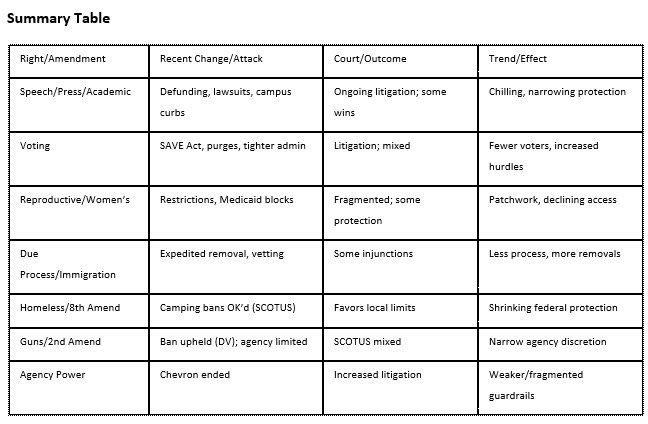
Concluding Note
The U.S. Constitution now faces a sustained, multi-pronged assault across its core guarantees. While the federal courts, especially the Supreme Court, remain a bulwark against the most direct violations, the method and pace of “legal” erosion pose historic risks. The outcome will depend heavily on the durability of civil society, the vigilance of the judiciary, and the collective action of citizens and local officials in the future.

#ConstitutionalErosion #DemocracyUnderThreat #CivilLiberties #VotingRights #FreePress #AcademicFreedom #RuleOfLaw #ChecksAndBalances #Federalism #EqualProtection #ReproductiveRights #LGBTQRights #DueProcess #MediaFreedom #FirstAmendment #VoterSuppression #AuthoritarianTrends #SeparationOfPowers #CivicEngagement #DefendDemocracy #JudicialReview #HumanRights #SaveOurConstitution #GovtOverreach #AmericanDemocracy
 | A guest post by
|
He has no idea about President. Other Citizens lives mean more than money. Chsrles gucked it up. Its not about Royals
anymore. Ive ammended the Criminal Code in the US and its Policy allready. MiniMe is the 1st thing on US Cops show. Ive got in my recordings its in my latest mini me compilation. The
Canadian Criminal Ive ammended all rational changes for the average family. Christ fucking sake man Vladmir Putin just igmored “PrinceCharles” for ME, an out loud Aubichon because
i gave a deadline to be on theWheel. Hes with theWheel. Soldier
Russian or any other Arny use my invention it is obvious when I
make changes “timedateplace” then the Earths rules change
after I do that. Now heres my plans for current electricity…
Nuclear Energy is not worth the risk to our Earth. Look we know
how coal works. We know everything about it. Remodelling any
current electrical devices makes no sense at all.” Lets all “Thinkaboutthe” task of changing. ITS NOT NECESSARY THAT WE CHANGE THE CURRENT SYSTEM OF POWER ON EARTH. U
Nuclear Scientists I think your on Crytal Meth all day every day
You are all gonna think twice about your plans. All these damn
changes aint fair to people with families, we have something to
lose. U do NOT. Am I wrong? Youd just as soon cause chaos
and “it will take all the electricity we have now to power ypur
goddamn Nuclear device. The internet is just a messaging service that pisses us off and your sons aint ready for war.
These kids think ripping off your grandparents is trendy “for
christsake”. Ive never once gone in my Grandma Elliotts purse
fucking ever or Grandad Elliotts wallet ever. Never once my
entire life! Thats what makes u a Man ready for the next task
We families are not signing on yout Nuvlear lies. We will have
to sign petitions but that well fucking do cuz we save kids in
need, u fucking sell them. Nuclear is not clear and thats just
the problem. ELECTRICITY WORKS JUST FINE IM GOING TO START CRIMINAL CODES FOR NUCLEAR PLANS OF ANY KNID
Menard Aubichon MP? PM? Walky Oppal Attorney General MP?